Pixel Structure Realism Report
Generated on 2026-06-06 from compass.geometry.sample_pixels and PixelStack.
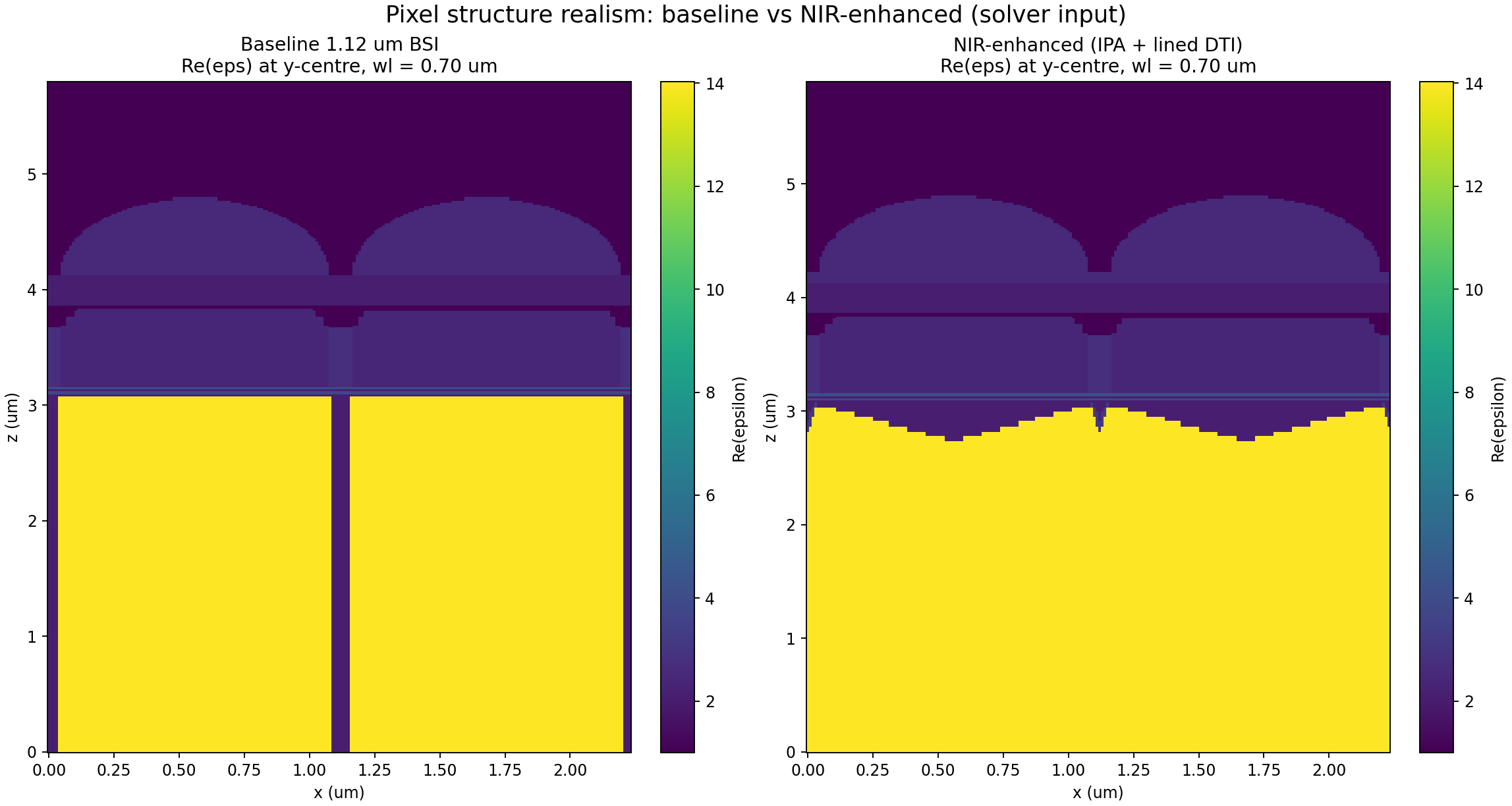
This report documents the structural-realism features COMPASS models for modern backside-illuminated (BSI) CMOS image-sensor pixels, and visualises them directly from the generated solver input. The cross-sections sample the real permittivity Re(eps)(x, z) the RCWA solver integrates, so this is geometry evidence rather than an optical-performance claim.
Why these features matter
- Backside inverted-pyramid texture (IPA). A graded silicon fill fraction at the backside acts as a moth-eye anti-reflection / light-trapping layer. Published simulations and process reports show large near-infrared QE gains (up to ~3x at 850 nm and ~5x at 940 nm) when an IPA is combined with deep DTI.
- DTI conformal high-k liner. Real backside DTI trenches are lined with a thin high-k film (Al2O3 / HfO2 / Ta2O5, ~30-100 nm) that passivates the etched silicon and carries a negative fixed charge. Optically it is a thin high-index ring between silicon and the lower-index trench fill.
- Tapered DTI sidewall. Etched trenches narrow with depth; a vertical-wall idealisation over-counts the isolation oxide deep in the substrate.
- Microlens residual base. Reflow / etch-back leaves a flat polymer slab under the curved cap; the lens is never zero-thickness at its edges.
Baseline vs NIR-enhanced pixel
Silicon backside detail
The graded Re(eps) of the inverted-pyramid texture produces a smooth effective-index transition from the trench fill toward bulk silicon, while the tapered DTI trench and its high-k liner are visible at the pixel boundary.
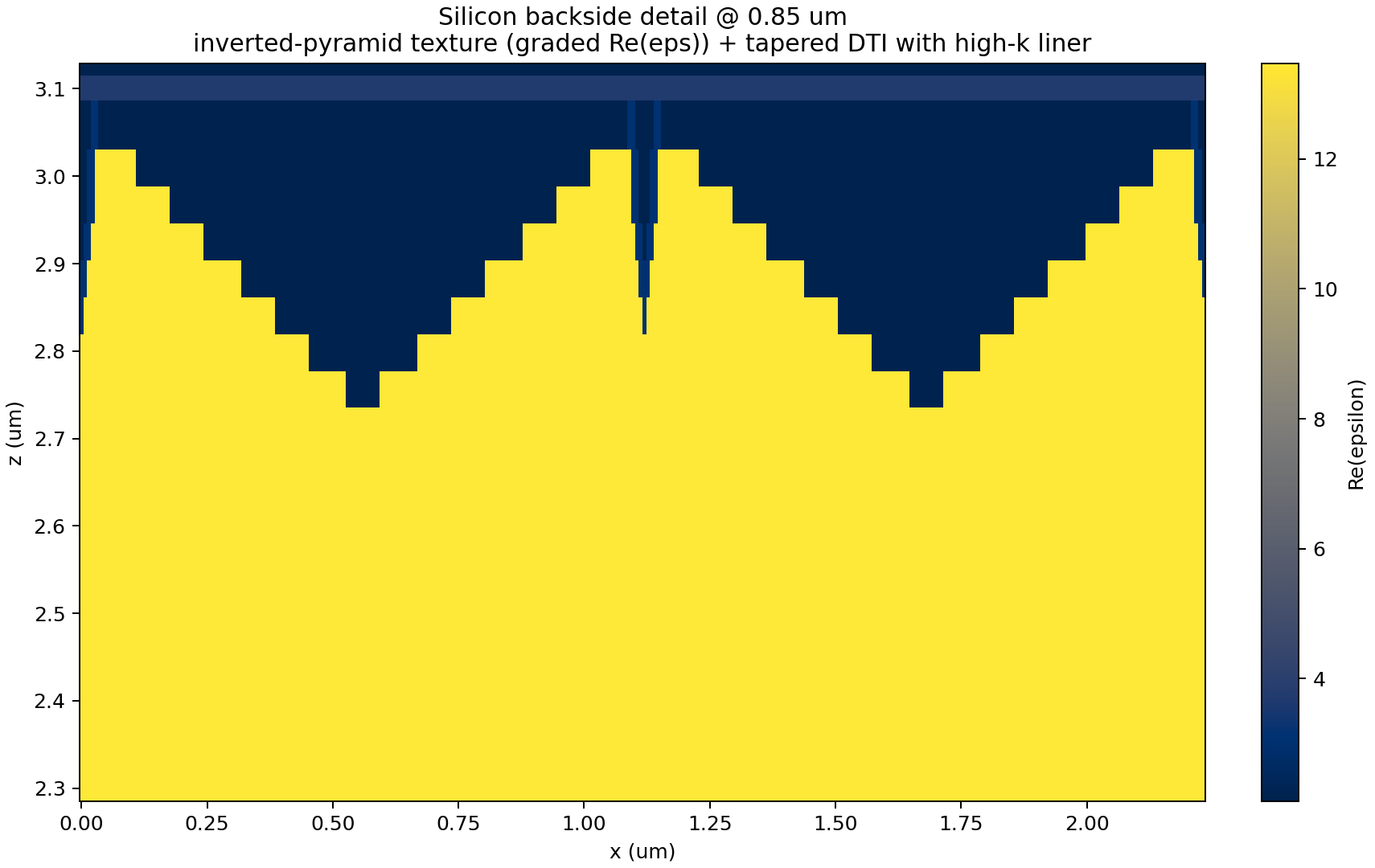
- Texture height: 0.350 um
- Area-averaged effective index across the texture: 1.46 at the surface to 3.67 toward the apex (monotonic graded-index anti-reflection).
Capability coverage matrix
| Real-pixel feature | COMPASS status | config key |
|---|---|---|
| Microlens superellipse profile + CRA shift | modelled | microlens.profile, microlens.shift |
| Multi-pixel shared lens (2x2 / 4x4 OCL) | modelled | microlens.sharing |
| Microlens residual base layer | modelled (new) | microlens.base_thickness |
| Per-color CF thickness + contact-angle relief | modelled | color_filter.<color>.thickness/contact_angle |
| Metal grid (W) with rounded corners | modelled | color_filter.grid |
| BARL anti-reflection multilayer | modelled | barl.layers |
| FDTI / BDTI deep trench isolation | modelled | silicon.dti.mode/depth/width |
| DTI conformal high-k passivation liner | modelled (new) | silicon.dti.liner |
| Tapered DTI sidewall (etch profile) | modelled (new) | silicon.dti.taper_angle |
| Backside inverted-pyramid light-trapping texture | modelled (new) | silicon.surface_texture |
| Photodiode collection window | modelled | silicon.photodiode |
| Composite / air-gap metal grid liner | roadmap | - |
| In-pixel light pipe / inner lens | roadmap | - |
Reproduce this pixel
python scripts/run_simulation.py pixel=sample_p1p12um_nirOr derive a config in Python:
from compass.geometry.sample_pixels import derive_parameters
from compass.geometry.pixel_stack import PixelStack

cfg = derive_parameters("sample_p1p12um_nir")
stack = PixelStack({"pixel": cfg})
Regeneration
python scripts/generate_realism_report.pyGenerated metrics are stored at docs/public/reports/geometry/structure-realism/structure_realism_metrics.json.