CRA Cone Illumination Sweep
Generated on 2026-06-11 from ConeIlluminationRunner and the real PixelStack path.
This report validates the cone-illumination workflow before using it for larger edge-of-sensor studies. It separates cheap planar-stack integration checks from a low-order patterned torcwa smoke run.
Executive summary
- TMM cone integration was swept over 5 sampling methods and 4 sample counts; the worst sampled max |A-A_ref| was 0.0068, and the best 49-point result was 2.72e-05.
- CRA/F-number maps were generated for CRA 0, 10, 20, and 30 deg across F/1.4, F/2.0, F/2.8, and F/4.0 using a 49-point Hammersley cone.
- The patterned
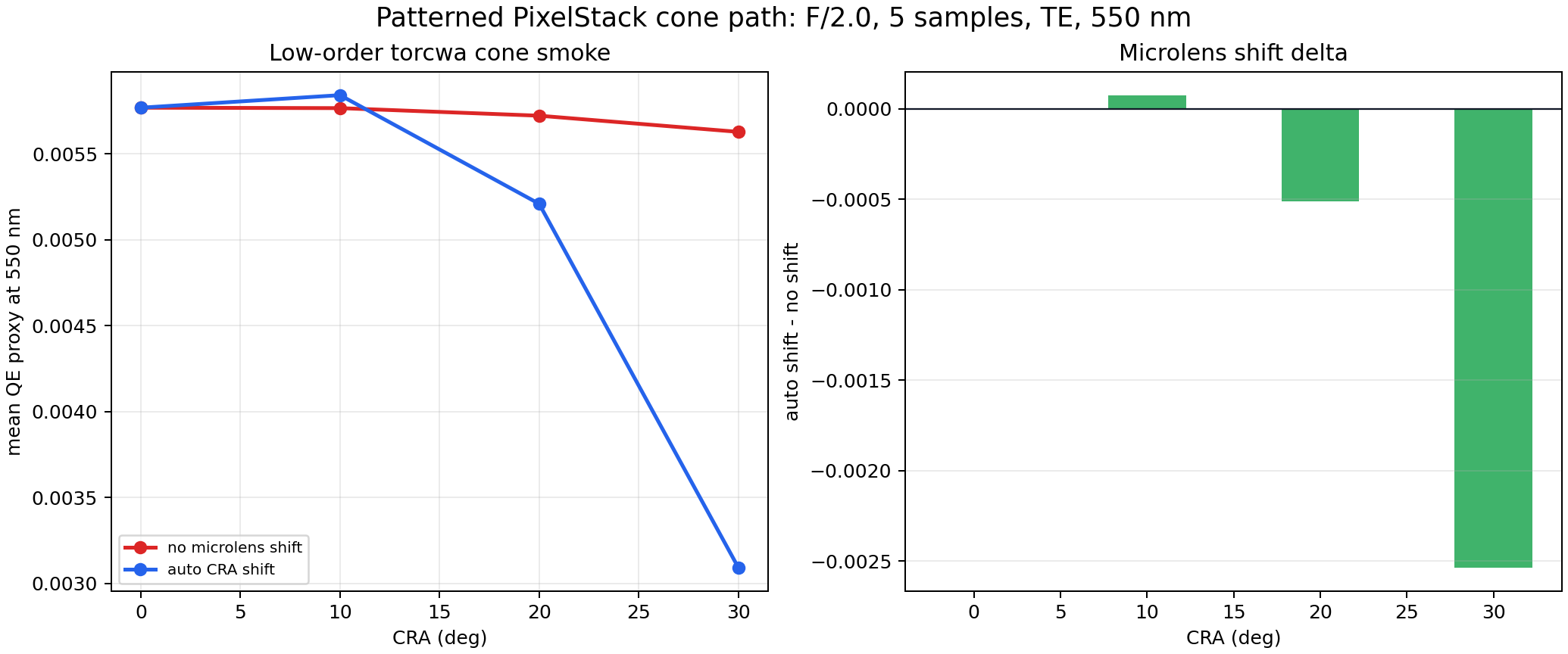
torcwasmoke run used F/2.0, five angular samples, TE polarization, and 550 nm. The auto-shift mean-QE delta ranged from -0.0025 to 7.54e-05 in this low-order check.
Scope
The torcwa section is a low-order path check, not a converged edge-pixel design result. Use it to verify that CRA and microlens shift are wired into the solver path, then increase Fourier order and cone samples for production.
Cone Sampling Maps
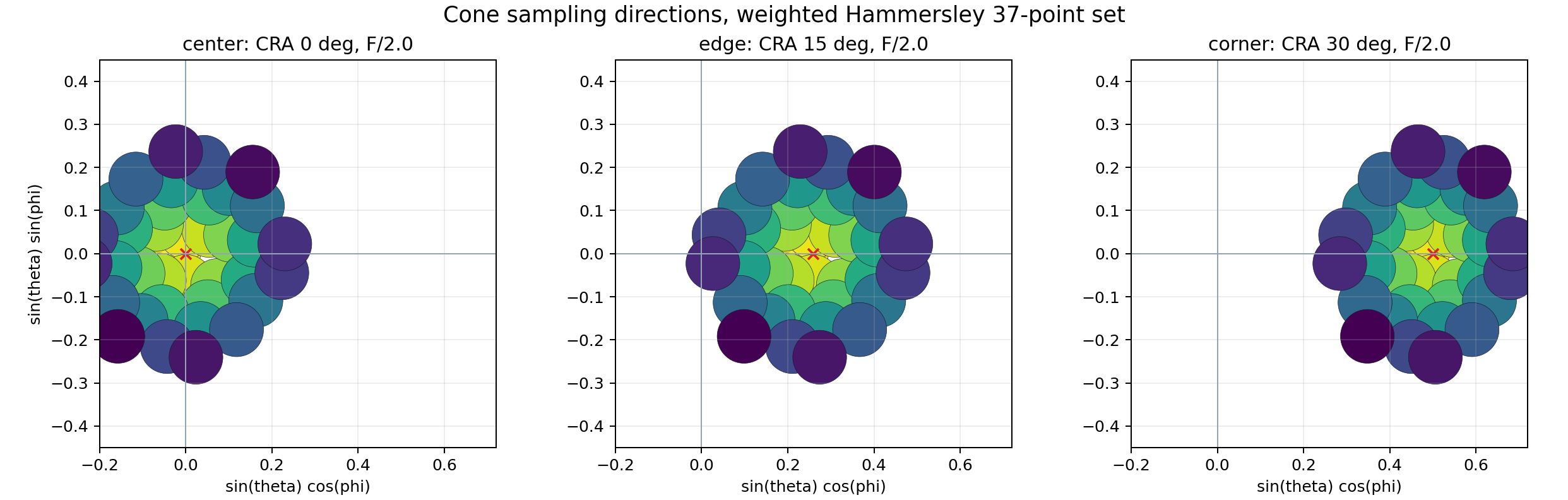
The red cross marks the chief ray. Marker area follows the normalized cone integration weight.
TMM Integration Convergence
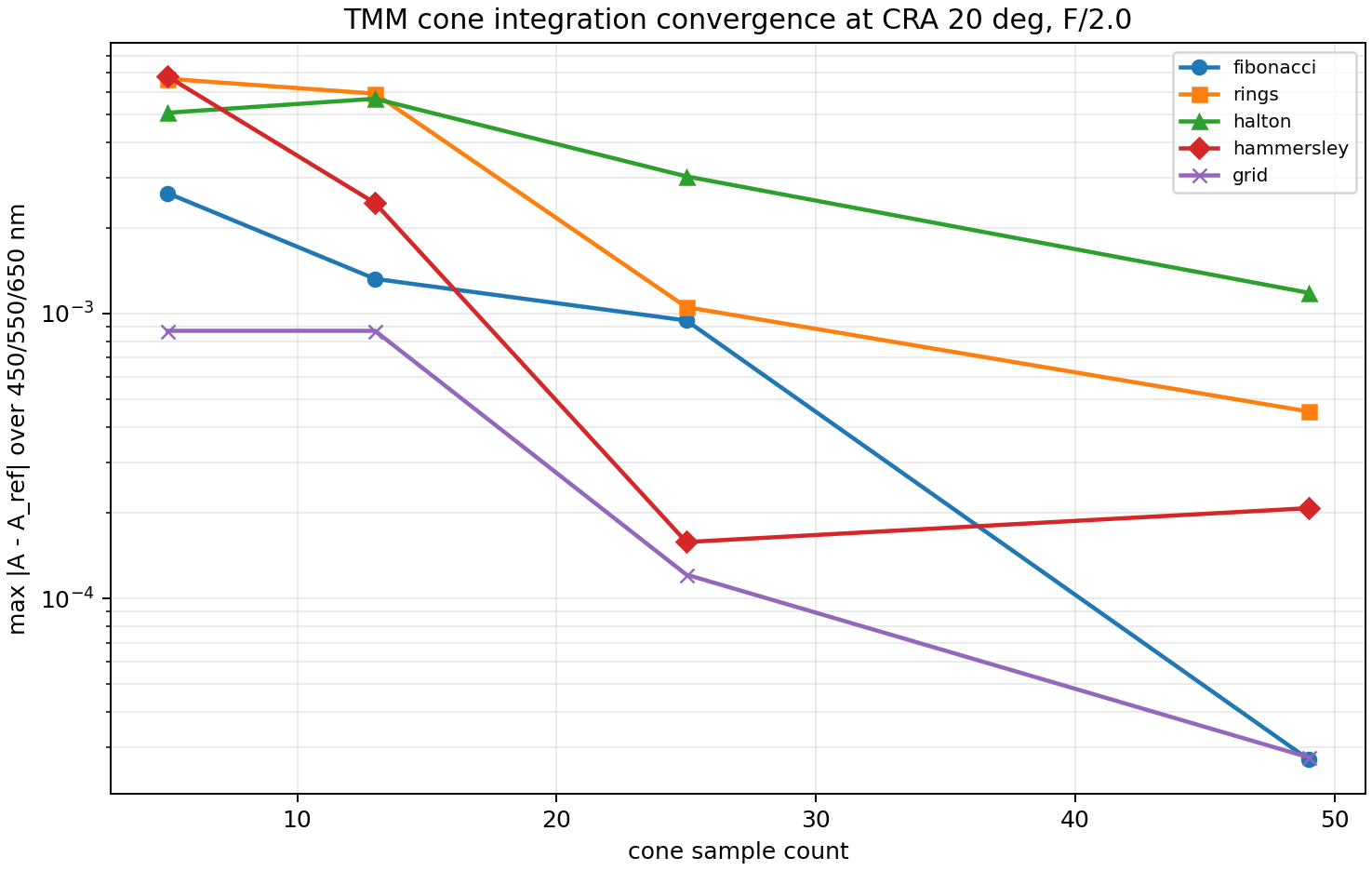
Reference: TMM, CRA 20 deg, F/2.0, 181-point Hammersley cone, wavelengths 450/550/650 nm.
| sampling | 5 pts | 13 pts | 25 pts | 49 pts |
|---|---|---|---|---|
| fibonacci | 0.0026 | 0.0013 | 0.0009 | 2.72e-05 |
| rings | 0.0067 | 0.0059 | 0.0011 | 0.0005 |
| halton | 0.0051 | 0.0057 | 0.003 | 0.0012 |
| hammersley | 0.0068 | 0.0024 | 0.0002 | 0.0002 |
| grid | 0.0009 | 0.0009 | 0.0001 | 2.77e-05 |
CRA and F-number Response
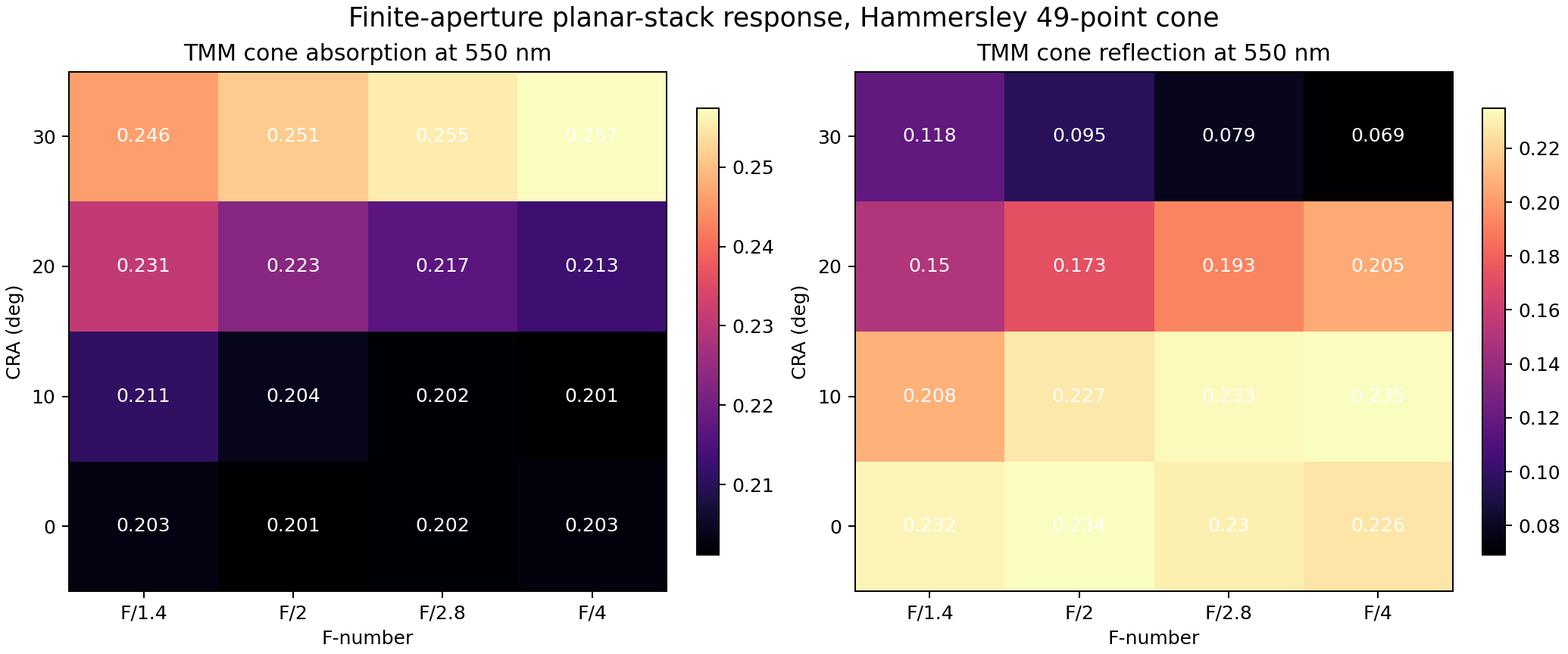
| CRA | min A@550 over F/# | max A@550 over F/# | range |
|---|---|---|---|
| 0 | 0.2012 | 0.2031 | 0.0019 |
| 10 | 0.2013 | 0.2109 | 0.0097 |
| 20 | 0.2128 | 0.2309 | 0.0181 |
| 30 | 0.2462 | 0.2574 | 0.0112 |
Patterned torcwa Smoke
| CRA | shift | R@550 | T@550 | A@550 | mean QE@550 | QE_R | QE_G | QE_B | energy residual | runtime s | error |
|---|---|---|---|---|---|---|---|---|---|---|---|
| 0 | none | 0.0317 | 0.0007 | 0.9676 | 0.0058 | 0.0053 | 0.0061 | 0.0056 | 0 | 3.2284 | - |
| 10 | none | 0.0306 | 0.0007 | 0.9687 | 0.0058 | 0.0053 | 0.0061 | 0.0056 | 0 | 1.3253 | - |
| 20 | none | 0.0282 | 0.0007 | 0.9711 | 0.0057 | 0.0053 | 0.006 | 0.0056 | 0 | 1.3186 | - |
| 30 | none | 0.0231 | 0.0007 | 0.9762 | 0.0056 | 0.0052 | 0.0059 | 0.0055 | 2.22e-16 | 1.317 | - |
| 0 | auto_cra | 0.0317 | 0.0007 | 0.9676 | 0.0058 | 0.0053 | 0.0061 | 0.0056 | 0 | 1.365 | - |
| 10 | auto_cra | 0.0265 | 0.0007 | 0.9728 | 0.0058 | 0.0054 | 0.0062 | 0.0056 | 0 | 1.3738 | - |
| 20 | auto_cra | 0.0215 | 0.0006 | 0.9778 | 0.0052 | 0.0052 | 0.0055 | 0.0045 | 2.22e-16 | 1.3694 | - |
| 30 | auto_cra | 0.0193 | 0.0004 | 0.9803 | 0.0031 | 0.0032 | 0.0036 | 0.0021 | 2.22e-16 | 1.2832 | - |
Interpretation
- In this symmetric planar TMM gate, grid and Fibonacci both converge tightly by 49 samples. For patterned RCWA workflows, low-discrepancy sampling remains the safer default because it avoids structured angular bias.
- TMM isolates the angular-integration behavior from lateral pixel geometry. That makes it useful for convergence gates, but it does not model microlens focus or crosstalk.
- The
torcwasmoke run exercises the actual patterned PixelStack path. The numbers are intentionally labeled as QE proxies because the Fourier order and sample count are deliberately small.
Regeneration
uv run python scripts\generate_cra_cone_report.pyGenerated metrics are stored at docs/public/reports/cra-cone/cra_cone_metrics.json.